Monday, December 14, 2009

Are We There Yet?


"The hurdles are finding the political will to rip out the old energy economy and put in a new one — and finding the money to pay for it.

Building clean coal or nuclear power plants is very expensive. Many of the nation's existing coal plants still need to operate for years to pay off the debt incurred to build them.

Making wind and solar power affordable and accessible will also cost a lot of money. And a limit on greenhouse gas emissions for industry will, at least for a long time to come, raise the price of energy." -NPR.org

There is no point in sugarcoating the truth. Representatives from nearly 200 countries

are rendezvousing in Copenhagen for two weeks to finagle over the global warming issue and attempt to overturn the Kyoto Protocol, a policy that expires in 2012.

"About half the electricity Americans use comes from burning coal. China depends on coal even more and is building new coal-fired power plants at a furious rate. Yet burning coal puts out more greenhouse gases than does any other single source of electricity.


Most energy analysts argue that the nation can't just turn off its coal plants and replace them in a hurry. The solution, according to the Department of Energy, is in part to switch to "clean coal." That generally means using coal in a different way — not burning it, but extracting energy from coal chemically, while diverting the carbon dioxide from the coal and burying it instead of letting it go up into the atmosphere."

So while it is decent and progressive to consider alternative resources, we must approach the most practical solution at the present moment: clean coal. Of course, as everyone knows, "clean coal is like dry water." Who wants to tackle China's resource quandary? America cannot even afford to take care of its own coal-dependency problem! Furthermore, funds would need to be pumped into the "carbon capture and sequestration," or CCS process, in which CO2 would be pumped underground in "out of sight, out of mind" fashion.

"Currently, the United States gets about 20 percent of its electricity from nuclear power plants, which do not emit greenhouse gases. The Obama administration is on record saying that new nuclear power plants are "in the mix" in its plans to lower the energy economy's carbon footprint. Nuclear power has popular support in Congress as well, and a few environmental groups are reconsidering it in light of its carbon "neutrality."

However, no one has built a new plant in the United States in decades. Besides concerns about the environment and nuclear waste, the reluctance of investors to pay for nuclear construction has stifled growth of the industry."

Wind and solar power are not faring so well either. For being ephemeral resources and mainly obtained from the sunny and windy southwest and Big Plains regions, the northeastern and Midwestern states do not reap the benefits of these Eco-friendly energy products. Electricity grids would have to be constructed to reroute wind and solar energy, a project that could take decades and estimated to cost a whopping $100 billion.

"The primary means of reducing greenhouse gases under the Kyoto Protocol is a cap on the amount of greenhouse gases emitted by industries. Signatory countries have targets for the period 2008 to 2012 for lowering emissions.

Most of the offsets sold internationally have been projects that limit greenhouse gases from factories, landfills or livestock waste ponds. Recently, many groups are trying to add forest management and agricultural practices to the list of allowable offsets. For example, a program called REDD (Reduced Emissions from Deforestation and Degradation) is being negotiated by environmental groups and businesses. It would essentially pay tropical and other developing countries not to cut down forests as fast as they have in the past.

Changing the way land is used is another way to generate carbon credits or offsets, since land and what grows on it can influence the flux of carbon into and out of the atmosphere. Experiments are under way, for example, to boost the rate at which grasslands and soil take CO2 out of the atmosphere. If that takes extra CO2 out of the atmosphere, it would generate carbon credits. No-till farming also might keep more greenhouse gas in the soil than conventional tilling, since it doesn't disturb the soil as much and thus keeps more carbon out of the air."

All excellent ideas: managing energy efficiency at the global corporate level, condoning anti-logging practices, and encouraging sustainable agriculture, inject creative thought into the quest for reducing the massive carbon footprint. Currently, 80% of carbon emissions are produced by 10 countries, including China, Russia, and the U.S. Sadly, we do not have an infinite amount of time to ponder over this conundrum and as our resources wane, the populations increase, and the obstacles to finding cost-efficient and environmentally sustainable production of energy seem insurmountable, our future appears pretty bleak.

Giant Lobsters


Carbon emissions prompt lobsters to develop thicker shells, thus enabling them to grow nearly 50% larger than normal exoskeletons. Simulated environments with high levels of carbon also precipitate bigger crabs and shrimps. While this might be good for the restaurant business, it doesn't necessarily mean that such large crustaceans will thrive in their natural habitats. While CO2 is beneficial for exoskeleton growth, clams, scallops, oysters and other "calcifiers" developed thinner shells under extended exposure to high levels of carbon. Incidentally, these species form a great portion of the lobster's diet. What bittersweet, global-warming irony...
Check the article out at NPR.org: "Giant Lobsters From Rising Greenhouse Gases?"

Sunday, December 13, 2009

Science Meets Art!!

Fantastic! A botany major rescinds great dreams of scientific grandeur for art making! It is kinetic art that utilizes the forces of nature (the phenomena of pendulums, gravitational and concentric pulls, e.g.). Ned Kahn even uses the aesthetics of auditory stimuli in his work. The sculpture depicted is made out of teak wood. Formed to be a "turbine" of sorts, the material was steamed and then warped into the inwardly spiraling shape.


"Artists use their creativity to reveal the world in new and sometimes unexpected ways. Artist Ned Kahn's work focuses on the physical world. From the harmonies of randomness to the dynamics of the Earth's crust, Kahn uses scientific principles to create mesmerizing works of art.

Kahn started out in college as a botany major, but gave up when he saw the three-inch-thick textbooks filled with Latin names. After graduating from the University of Connecticut, he headed west. One day he stumbled into the Exploratorium, a San Francisco museum dedicated to the natural world and the forces that shape it, and he was hooked. He begged for a job and was offered an apprenticeship with one of the machinists who built the exhibits.

Kahn's first piece for the museum was enormously popular -- a metal bar dipped into a trough of soapy water, then hoisted into the air by ropes on either side. A giant film of soap would stretch from bar to trough. With just the right lighting, patterns and colors would reveal themselves dancing across the film.

Dozens more exhibits followed. Chaotic pendulums, smoke vortexes, wind-sculpted dunes. Most of the pieces are visual, but some are musical.

One such work, on display recently at the Sebastopol Center for the Arts in Northern California, consists of a spinning disk and tiny steel bearings. The balls drop through a grid of nails, creating tinkling musical sounds as they fall. Kahn says the work had started out as a math demonstration, "but the sound these nails made in this board was compelling."

Kahn says he's most satisfied when people see his work and share that sense of wonder and delight that he feels for the processes of nature.

"I've tried to create things where I've basically framed a phenomena, and I'm letting nature do the sculpting," he says.""


"Science and Art: An NPR Article"

Saturday, December 12, 2009

Alternative Modes of Transportation


I get it! You can be a walking pedestrian and a cyclist at the same time! And this is recycled art, right? While some people casually toss their worn shoes into the trash, this anonymous clever fellow came up with an ingenious way to fix his flat bike tires and utilize worn-out shoes.

Thursday, December 10, 2009

Welcome to Kentucky


For the past eight years, my family has lived on a 100-acre farm in LaRue County Kentucky, near the small town of Hodgenville (birthplace of Abraham Lincoln). Over the years, we have noticed a startling change in the landscape: trees are being cut down rapidly, logging roads delving into the depths of the deep old-forest growth, and felling many ancient trees. Our property has become an island of sanctuary, prohibited from loggers. We even keep hunting on our land to a minimum. We hope that by keeping evasive human involvement to a minimum (save for the livestock and animals we have introduced to the land) endangered species will have a small chance of establishing a foothold in the hills of rural central Kentucky. Think we don't have any threatened organisms in our state? The US Fish and Wildlife Service's Endangered Species Program has compiled a list:

Bat, gray (Myotis grisescens)
Bat, Indiana (Myotis sodalis)
Bat, Virginia big-eared (Corynorhinus (=Plecotus) townsendii virginianus)
Bean, Cumberland (pearlymussel) (Villosa trabalis)
Beetle, American burying (Nicrophorus americanus)
Catspaw (=purple cat's paw pearlymussel) (Epioblasma obliquata obliquata)
Clubshell (Pleurobema clava)
Combshell, Cumberlandian (Epioblasma brevidens)
Crane, whooping (Grus americana)
Curlew, Eskimo (Numenius borealis)
Dace, blackside (Phoxinus cumberlandensis)
Darter, relict (Etheostoma chienense)
Eagle, bald (Haliaeetus leucocephalus)
Elktoe, Cumberland (Alasmidonta atropurpurea)
Fanshell (Cyprogenia stegaria)
Mapleleaf, winged (Quadrula fragosa)
Mucket, pink (pearlymussel) (Lampsilis abrupta)
Mussel, oyster (Epioblasma capsaeformis)
Mussel, scaleshell (Leptodea leptodon)
Pearlymussel, cracking (Hemistena lata)
Pearlymussel, dromedary (Dromus dromas)
Pearlymussel, littlewing (Pegias fabula)
Pigtoe, rough (Pleurobema plenum)
Pimpleback, orangefoot (pearlymussel) (Plethobasus cooperianus)
Plover, piping (Charadrius melodus)
Pocketbook, fat (Potamilus capax)
Puma (=cougar), eastern (Puma (=Felis) concolor couguar)
Riffleshell, northern (Epioblasma torulosa rangiana)
Riffleshell, tan (Epioblasma florentina walkeri (=E. walkeri))
Ring pink (mussel) (Obovaria retusa)
Shiner, palezone (Notropis albizonatus)
Shrimp, Kentucky cave (Palaemonias ganteri)
Sturgeon, pallid (Scaphirhynchus albus)
Tern, least (Sterna antillarum)
Wartyback, white (pearlymussel) (Plethobasus cicatricosus)
Wolf, gray (Canis lupus)

Transgenic-Eduardo Kac

Eduardo Kac, creator of the Fluorescent Green Protein bunny named Alba was the inspiration behind this design as part of the final project for the Media, Issues, and Sustainability class. Kac was also responsible for the work Genesis, in which a scripture of the Bible was translated via morse code into a DNA codified strip of information that was injected into continuously growing bacteria. Every time a person logged onto the website of the the Genesis Project, a light would shine on the petri dish where the organisms were flourishing, thus prompting them to "evolve" and be genetically manipulated by the humans from afar. We might consider common household domestication to be a slightly less controversial form of transgenic artwork...

"Poo Power"

"Fecal Matter has Great Potential Energy"

Sewage plant
The waste is processed and made into blocks which are burned

A water firm says it saved £15m last year - by using human waste to make electricity.

In 2008/09, Thames Water generated 14% of its power from either burning sludge or methane derived from the 2.8 billion litres of sewage it treats every day.

The company hopes the move will ultimately help it cut greenhouse gases by 20%.

More than 13 million people in London, Berkshire, Oxfordshire, Hertfordshire and Surrey are served by Thames Water.

Dr Keith Colquhoun, Thames Water's climate change strategy manager, said: "There's no polite way of saying this but what we produce - our poo - isn't simply waste, it's a great source of energy.

"The solids in sewage have a high calorific content that we use to generate electricity.

"This isn't a gimmick. As well as helping us to be more sustainable as a company, it also saves money - £15m less of customers' cash spent on National Grid energy last year alone, which ultimately has a downward pressure of bills.

"Our goal is to cut greenhouse emissions by 20% on 1990 levels by 2020 - that's about 200,000 tonnes less CO2.

"By using poo power and other renewable energy sources, we're making significant progress towards this target."

-BBC News online

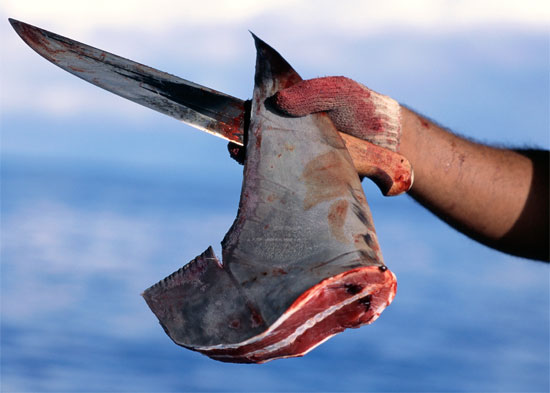
Photographer Norbert Wu


"Shark Fins Left to Dry"

The link goes to the photography site of Norbert Wu, the professional photographer who was rewarded the "Pew Marine Conservation Fellowship, the world's most prestigious award in ocean conservation and outreach. Through 2003 he used this grant to document, in stills and high-definition video, the world's most unique and threatened underwater habitats, assembling a large library of images related to marine conservation." These images are slightly disturbing and definitely disheartening when we speculate about our greedy preoccupation with the fruits of the sea, including shark fin soup and other delicacies that fetch a high price on the global market. Culture and cohabitation conflict when the demand for ocean resources exceeds the amount of organisms (sharks, loggerhead sea turtles, sword fish...) trying to survive and keep the precarious food chain in balance.

Sympathy is our greatest survival method

"We Are Sympathetic Species"
Interesting article about altruism and the evolutionary benefits it has bestowed on us. Could this explain our empathy for the people who don't even exist, i.e. our progeny, the proverbial people who will inherit the earth when we pass away? Could this be our reasoning why we seek sustainable solutions, macro-managing and foreseeing a future with limited resources?

Where is my mind?

I just realized how unusual it has been for me this past semester. I have not openly discussed religion with too many people in any of my art classes. Always a pervasive issue, many of my peers considering I have an irritating chip on my shoulder, I have actually been very reticent about my zealous atheism. Lest we forget the wacky people out there who are more foul-mouthed and choleric as me... science fiction writer, Harlan Ellison.

Sunday, December 6, 2009

Recycling Doesn't Work: Ultimate Fail


"The Recycling Conundrum"

So the National Post has declared that recycling is just a waste of funds and Co2 emissions skyrocket due to the need for surplus garbage vehicles and other required recycling implements. Plastic is cheap. Aluminum and paper are the items that need to be recycled. This is depressing. To come to the conclusion of this class to discover an article that reveals how futile it really is to try to maintain a sustainable lifestyle and community initiatives just supports my nihilism. So what do we do with recyclable materials? Turn it into art.

Monday, November 30, 2009

Recycled Art Reinvented?

Sheep! Made out of telephone materials! Ingenious, startling, and nostalgic. Why can I never think of these things...

New Recycled Art Stuff!


Sunday, November 29, 2009

Bonobos Need Love Too

Bonobo born at the Jacksonville Zoo! The 24-year old mother is very proud of her unnamed new female daughter. Hitherto reading about this event, I had not imagined bonobos were kept in captivity because of their promiscuous ways that might scandalize the zoo and offend the public. Despite their reputation for sexual communual behavior, bonobos are very kind and intelligent primates. They can be called the "make love not war" chimpanzees, their very close genetic relatives. They face habitat destruction in the Democratic Republic of the Congo.

Friday, November 27, 2009

Science + Artistic Ingenuity= "Art of Science Competition"

Princeton University student shows adept prowess in creating artwork made from the manipulated molecular makeup of organisms.

Worm Window
Erin Cram
Department of Molecular Biology
This work is based on the rose window of St. John the Divine, NYC. Each segment of the image is an image of the microscopic nematode, C. elegans. The red images were generated by staining the animals with a dye called rhodamine-phalloidin, which lights up actin, a protein found predominantly in muscles. The blue is a DNA stain called DAPI, and the green comes from expressing the jelly fish protein GFP transgenically in the nematodes. The grayscale images are mainly of C. elegans embryos or dissected C. elegans organs. Although the work was assembled using Photoshop, none of the image is pseudocolored.
"American Decadence"

Holiday goodwill ignores the cries of the hungry. Forty percent of the food produced in the United States is casually discarded. Over 1 billion people worldwide do not have their dietary, nutrition needs met. Surprisingly, this wanton consumption and disposal of food products also has detrimental effects on the environment as well.
"'Addressing the oversupply of food in the United States could help curb to the obesity epidemic as well as reduce food waste, which would have profound consequences for the environment and natural resources," the scientists write. "For example, food waste is now estimated to account for more than one quarter of the total freshwater consumption and more than 300 million barrels of oil per year representing about 4 percent of the total U.S. oil consumption."'
Amazing!

Monday, November 23, 2009

Recycled Art Project!!


My artwork involved rummaging through a worn, paper bag filled with the objects I had hastily collected from my car. I was selling it and before the transaction, I removed all of the old cds, miscellaneous odds-and-ends, a pack of playing cards, flashlight, bumper stickers, a kitschy koala clip from Australia, a bracelet, a cord that would connect my Ipod to the stereo, and an air freshner. The beer bottles had already been thrown away. I had arranged these objects in a mandorla around an altar built from cds, the pedestal for the flashlight, air freshner, and koala. The playing cards were placed in such directions as to emphasize the continuous, cycle of merchandise, commerce, and the increasing reliance on vehicles, the abodes that essentially fulfill a second domicile for us. Above this sacred layout is a bumper sticker that once adorned my Toyota 4-Runner. It is an Albert Einstein quotes: "Only tow things are infinite: the universe and human stupidity. And I'm not sure about the former." Witty, sardonic, and critical. I wanted to empathize with the disinterested non-vehicle owning person and support the efforts to exclude oneself from dependency on motor transportation. I believe I made the right decision when I decided to sell my car.

Saturday, November 14, 2009

Finally!! Artistic Documentation with a purpose


"Polar Obsession"

NPR has a fascinating article about National Geographic photographer Paul Nicklen who has spent 20 years documenting inclement polar regions through his astounding photography. Having been raised in the Canadian Arctic he is quite familiar with extreme temperatures, the volatile dangerous nature of leopard seals, grizzly bears, and elephant seals, and a life of solitude. Despite endangerment to his life, Nicklen says that it is all worth it. '"How are people supposed to care about the environment when they're living in a cement jungle?' he wonders in the interview. To make them care, he goes to extremes. Nicklen is on a mission to bring these remote habitats to those of us who may never see them, to make us care about the endangered polar ecosystems and the animals that inhabit them. His photos appear in a new book, Polar Obsession, published by National Geographic. "
My comments: There is finally a person championing the cause of environmental awareness through photography (art) with the focus on animals in realms that are on the perilous edge annihilation. When the peat moss in the Arctic starts to thaw and begins to release huge quantities of carbon emissions, humans-gluttonous, self-satisfying and congratulatory, greedy and consumptive creatures-will not be the only organisms to suffer. Paul Nicklen is a refreshing anomaly, a person who is risking his life to capture beautiful, fleeting moments of natural animal behavior.

Tuesday, November 10, 2009

Choose your produce wisely...


< "Which Fruits, Vegetables, and other Crops have the smallest environmental footprint?"

A nice accessible article about which produce require the least amount of pesticides, land consumption, and energy. Some observations: eat more soy and beans, avoid raspberries and bananas, and rule of thumb, always buy the cheapest products that usually required less fertilizer, land, energy, and pesticide use.

Sunday, November 1, 2009

International Awareness about Alternative, Cleaner

"This is my Australian cousin and she's really environmentally conscious!"

Eleri Mai Harris conducting an interview for RMITV current affairs program, "Newsline." Not entirely sure what the background story is but I overheard some bits mentioning the migration to greater usage of public transportation. Still, most Australians live on the coastline, i.e. major cities, many don't necessarily need a car thus prompting them to use alternative, cheaper modes of transportation. The Aussies on average have lower carbon foot prints than Americans do; they are also hyper-conscious of water shortage and take adamant measures to avoid wasteful consumption.

Tuesday, October 27, 2009

A lament for our fellow brethren


"The Bushmeat Commercial Market"

Environmental Social Justice Issue Revisited: the Illicit Bushmeat Trade

There is corrupt business afoot in the world when animals are poached, their carcasses distributed across a secondary-market for food and other commodities. The destructive affair has led to the deterioration of animal species, notably the gorilla, chimpanzee, and bonobo populations in Africa. Bushmeat hunters will slaughter 200 billion dollars worth of animals this year, including 8,000 endangered apes. According to the Bushmeat Project, an environmental and humanitarian group that initiates alternative wage-earning opportunities for equatorial Africans, “[p]eople pay a premium to eat more great apes each year than are now kept in all the zoos and laboratories of the world. If the slaughter continues at its current pace, the remaining wild apes in Africa will be gone within the next fifteen to fifty years” (bushmeat.net). Partnerships between animal conservation groups across the world have increased awareness and specific concern for the people seeking economic recourse in a destructive trade that not only affects the biosphere of west and central Africa, but an indigenous way of life. A significant mantra of environmental organizations is to turn “poachers into protectors,” in an attempt to divert financial interest in hunting and logging to conservation and tourism. Evoking empathy from the public and encouraging resistance toward purchasing bushmeat, progress has been made; take away the incentives and commercial hunting of endangered species will hopefully wane.

What's wrong with a normal hobby...like cycling or fly fishing?


"Why the Hell would you create such a thing?"

This is so bizarre...of course the man who created a motorized Lazy-B chair that included the perks of a "stereo sound system, nitrous oxide booster, parachute, headlights, a steering wheel, and a sticker that reads: 'Hell yeah, it's fast,' would get arrested for driving his unorthodox vehicle into a parked car while intoxicated. The chair can reach speeds up to 20-mph; is it sustainable you might ask? If so, I foresee a future where everyone will scoot around in comfort on a fashionable chair, powered by vegetable oil, a shoddy version of a vehicle that you can hurl off a cliff and land safely on the ground with the assistance from your parachute. The ingenious piece of mechanical engineering will be auctioned off on Ebay. Check your bank accounts because this item is definitely a must-have!!

Tuesday, October 20, 2009

Taxidermied Chupacabra Attracts the Attention of a Wacky Creationist


Chupacabra? Creationist Museum Displays Mystery Beast

Really? An authentic "Chupacabra," an enigmatic creature that resides in Mexico and known for killing small livestock, has typically been called a fictional animal; a kindred spirit to the Lochness monster and Big Foot, Chupacabra carcasses have traditionally been revealed through DNA tests to be a native, hairless Mexican dog called Xoloitzcuintli or a mangy coyote. This recently acquired Chupacabra's DNA tests are yet to be revealed. Most importantly, John Adolfi, manager of the "Lost World Museum" in Phoenix, New York who purchased the taxidermied carcass, "wanted to exhibit the beast as an example of the fallibility of science. His Lost World Museum (named after Sir Arthur Conan Doyle's 1912 novel in which dinosaurs still exist) features items and artifacts that he believes proves that scientists don't have all the answers. A creationist, Adolfi believes that the Earth was created 6,000 to 10,000 years ago by God. He believes that by displaying the chupacabra, he will cast doubt on the credibility of mainstream scientists: If scientists scoff at the chupacabra's existence, could they be wrong about evolution and the age of the Earth?" My response: yeah, believing that the earth is 6,000-10,000 years old negates any type of credibility to his outrageous theory.

Sunday, October 18, 2009

"Smug Alert!" Be careful you don't get too patronizing, i.e., when it comes to being environmentally conscious, humility is key!

The creators of the satirically critical and surreal show "South Park," Matt Stone and Trey Parker, point out the hypocrisy of smug Hybrid car owners in the Season Ten episode "Smug Alert." When Kyle's dad purchases a Hybrid Prius, his patronizing attitude alienates his family from the rest of the down-to-earth, commonplace people of their hometown South Park. Being green can take a nasty toll on one's social life if you become too congratulatory about your eco-friendly behavior and subsequently criticize others for not following your exemplary, metropolitan behavior. Crude and ultimately offensive, "South Park" calls attention to everyone's bullshit, even the people who are actually taking positive steps towards sustainability and reducing carbon emissions. Keep it real, guys.

Thursday, October 15, 2009

Cultural Diversity in the Gadgets we Choose


6 Gadgets Japan Loves (and the U.S. rejected)

Japan loves sleek, shiny elongated skinny phones. The Japanese also enjoy bidets (there is an "energy saver" option button on the luxurious toilet), massaging chairs in their living rooms, seated showers, and really small laptop computers. To be succinct, cute gadgets that Americans felt were too superfluous or avant-garde.

Wednesday, October 14, 2009

Panda Pumpkin


What's better than a cute panda? How about a panda carved into a pumpkin purchased from a local farm! "Illuminating" the issue of devastating apathy towards endangered species and the benefits of buying produce without paying for superfluous financial and environmental expenses.

Thursday, October 8, 2009

World-first Sustainable Racing Car Runs On Chocolate, To Take On Formula 3


href="http://www.sciencedaily.com/releases/2009/10/091005123048.htm#"

ScienceDaily (2009-10-08) -- Can the idea of "green motorsport" actually work? Yes, according a U.K. researcher who led the research team which designed and built the world-first fully sustainable Formula 3 racing car, which runs on biofuel made from chocolate and animal fats.

"But it's not just an environmentally friendly car, it is also fast. The car has a top speed of 135 mph, can achieve 0-60 in 2.5 seconds and is turbo charged to give it more torque."

This car is outstripping the competition! With a steering wheel made from carrot pulp, a recycled-resin and carbon fiber and woven flax body, this vehicle is fast and ferociously sustainable. The idea behind the project, spearheaded by Dr. Kirwan at the University of Warwick, was to advocate "being sustainable and green..." and it "can be incredibly sexy, fun and fast." Let's root on this green machine at the Formula 3 Championship on October 17th.

Monday, October 5, 2009

Billowing Polar Bears


Oh, the ephemeral fragility of animals...still, I'm a little befuddled. What social message are they trying to get across? Seems a bit convoluted, i.e., they are encouraging you to ride the subway, to fight global warming, and consequently save the polar bears. Hence, when the subway propels itself speedily under the pavement and creates the great whoosh of air that stirs the polar bears into life, the average pedestrian is supposed to comprehend this rather obtuse message. Well, if you live in the 21st-century and tend to avoid hiding under rocks, polar bears are the ubiquitous poster children of global warming. Interesting archetype.


Red Earth Environmental Art Group

The Red Earth collaborative art group, based in the UK, is an apt representative of the new avant-garde blossoming in the art world. A group of artists who are following ecological tenets and inciting responses from people in a global context are bringing light to important environmental issues such as the dwindling Suffolk coastline. The 2008 art project "Long Shore Drift is a response to the immediate and historical issue of land loss through geological transition and sea flooding, and the potential for the ecological restoration of an endangered habitat." Besides addressing Anglo-Saxon environmental concerns, the group's artistic influences span across the world; the 2001 art project "Breath" took place in the derelict Canterbury castle and was directly inspired by Japanese philosophy and aesthetics. Including performance and installation, "Breath" was intended to encapsulate the essence of life and the vulnerability of nature as a whole; we take our first inhale of breath when we are born and heave a last exhale before we die, synonymous with every living organism that thrives on earth, we are mortal. Installation in the project included:

A series of retreating and superimposed layers:

The floor is raked gravel, a zen map of all matter reduced to its most simple, symbolic form. Two large pools of water break the patterning, reflecting light and video. The contact of water with water resonates through the digital sound system.

At the centre of the castle space a cylinder, its base dark burnt oak. Steam seeps from within the cylinder. Its upper half - a ringed wall of thickly luminous wax.

Blank screens and a bamboo wall cut across the space; the space behind, the last space, is a dark.

Red ladder against the wall leads from water up to the still figure of a performer. Dead. Inert. Waiting to be born ­ waiting for their first breath.

Human/Body/Fluid
Red ladder. Screens of linen and wax. Yellow columns of beeswax lit from within with vitreous honey pools reflecting the structures below. Muted organic light, living fragile skins activated by video projection.

Nature/Vegetation/Animal
An assemblage of tall, bamboo poles, white and spectral; a forest, a cage, a wild place.

Earth/Mineral/Mountain
A mound of chalk: the earth moving, the course of minerals through the veins of the earth: earth as dust in which a performer will be enveloped.


The project "Java," that spanned the years between 1997 through 1999, included the collaboration of Javanese performance artists, an intellectual documentary journey into the culture of ritual and environmental union.

Saturday, October 3, 2009


Post-Human Earth: How the Planet will recover from us

This is a truly fascinating read! Positive nihilism reaches a new perfected level in this article! It discusses the reverberations of our actions that have stimulated a new geological epoch to emerge, urging a mass extinction to the forefront of history. Scientists have correlated the current global warming scenario to life in the"Paleocene-Eocene thermal maximum," 55 million years ago when temperatures worldwide rose approximately 9 degrees Celsius. The present-day crisis at hand is the melting of the ice caps, which will lead to the subsequent thawing of the Arctic carbon-rich peat that would release trillions tons of carbon into the atmosphere; methane from the ocean sediments would also disperse across the planet, creating a noxious environment that would surely be a devastating kick to the genitals of all organisms. Literally, reproductive success would plummet dramatically; the first species to go would be the endangered ones (goodbye panda and polar bears). We have already inhibited the migration patterns of many animals (constructed roads, geographical altercations, etc.) so the common trend of organisms following their respective climate across the globe (reflect back upon our migratory process throughout the world and subsequent adaptations) would be seriously hindered. The earth could virtually become sterile; still, life would persevere in the wake of tenacious evolution. Some critters would inevitably survive (cockroaches and rats) and millions of years later, a diverse blend of organisms could possibly emerge. We just will not be around to see it. Question of the day: what are we really trying to preserve or conserve with our ecological concerns and savvy preventative measures of deterring a mass extinction? For the continuation of our species? My forecast for the future: warm and sunny with a 0% chance of present-day humans succeeding in preventing the devastating, ineluctable outcome. Well, shit.

Thursday, October 1, 2009

Ecuador Greens Up!


http://www.wired.com/science/planetearth/magazine/17-09/st_galapagos#

"Every year, more than 140,000 tourists descend on the isolated archipelago to ogle its cactus-studded scenery and bizarre wildlife. And amid the blue-footed boobies and giant tortoises sits a handful of towns whose population has tripled to nearly 30,000 in the past two decades. To support all those people, 10 million gallons of diesel fuel and gasoline are shipped to the Galápagos annually, a fifth of which is used just to generate electricity."

Charles Darwin would be turning in his grave.

New Artwork: Drawing and the Incorporation of Animals

Well, it's not too much to look at right now, but the drawing is definitely a "work-in-progress" that I hope will culminate successfully. Why does this pertain to sustainability, environmental concern, and other related topics? The significant meaning lies within the context; the old goat my hand is resting upon is a recurring theme in my artwork; my modus operandi usually focuses on self-portraiture and a fictional setting that oftentimes includes representative animals that stand in for allegorical messages. The background of these figures will be adjunct to a corrosive metal shed, a building that actually exists on my leisure farm (I will try to find pictures of this monstrosity). It was there before my family arrived and it is a quintessential monument to the filthy habits and crass ways of rural Kentucky natives (yes, I am being deliberately offensive); it was filled with miscellaneous objects that had been stuffed inside this hideous structure; cars, laundry machines, and other large items too large to consider worth making a genuine effort to dispose were casually pushed down a ravine.

Tuesday, September 29, 2009

The Demise of Fish!

http://www.tnr.com/article/environment-energy/aquacalypse-now?page=0,0

Sunday, September 27, 2009

Vermin artwork


I have transformed the commercially manufactured wire cage into an environmental monument, testifying to the versatility and duality of organic material and plastic, metal constructions. One is consuming the other; things get a little more interesting when Eleanor the rat is introduced to the outside world. She at first retreats quickly into the jungle, labyrinth-like cage that is slightly familiar to her; I was amazed, however, by how quickly she assimilated into this hot, scratchy world where grass blades rose in sharp spires around the small creature,and insects whirred above her head. Perhaps it was simply naivete, but Eleanor seemed very comfortable in this environment; she even climbed out of the cage and started cavorting through the grass. Animals have an uncanny ability to readily accept their world and consequently explore it. There is also a piquant picture of Eleanor sniffing a bag of recycled animal bedding; the absorbent material is made from recycled paper and magazines. Animal owners are going green!

Saturday, September 26, 2009

Panda Genocide Advocates


Let Pandas Die out, Says Naturalist

Naturalist Chris Packham suggests the pandas have worked themselves into an "evolutionary cul-de-sac" without any recourse for survival. What a horrible person! Packham suggests we should pour the millions of dollars spent on resuscitating the panda population into other species that have a better chance of survival. He has the same nihilist opinion about wild endangered tigers as well, noting that they are worth more dead than alive. In regard to the panda, Packham states that:

"It's not a strong species. Unfortunately it's big and cute and it's a symbol of the WWF (Worldwide Fund for Nature) -- and we pour millions of pounds into panda conservation."

"I reckon we should pull the plug. Let them go, with a degree of dignity ..."

Fantastic. I'm for humanitarian euthanasia (concerning both humans and animals)but if 1,600 pandas are contentedly thriving within their environment, albeit a quickly disappearing one, the more power to the adorable creatures.

Thursday, September 24, 2009

Spiders: Arachnids Hired to Create Art

Gossamer Silk, From Spiders Spun

Well, this is nifty! An art historian revitalizes an archaic practice to create a beautiful fabric that used the clever natural skills of spiders (millions of them).

Sunday, September 20, 2009

Ephemeral Artwork in Progress


Well, I started the construction. After picking up various sticks from a nearby park, I arranged several of the pieces into a staggered line of some sort and stringed them together with hemp and ivy growing near my house using a series of knots and interweaving techniques to hold the constructed piece together. I also introduced the assemblage to my pet rat Eleanor (the healthy rat) and she investigated it briefly; I was surprised she wasn't captivated by the unusual smells and textures of the web-like structure. Still, I think it is a noble start.

Saturday, September 19, 2009

Reinventing the Forest:: Irrigating Deserts


http://sciencenow.sciencemag.org/cgi/content/full/2009/914/2

A multitrillion dollar operation that seems ludicrously impractical, utterly unfathomable, and counter-intuitive to preservation of the environment? Is that what it's going to take to save our planet? Planting heat-resistance shrubbery in the Sahara Desert and parts of Australia will apparently impede the global warming process. So "if most of the Sahara and Australian outback were planted with fast-growing trees like eucalyptus, the forests could draw down about 8 billion tons of carbon a year--nearly as much as people emit from burning fossil fuels and forests today. As the forests matured, they could continue taking up this much carbon for decades." I think the desert animals that have become so adept at living in the inclement environments should be consulted as well, albeit this idea seems a little unfeasible.

Thursday, September 17, 2009

Tony Blair the Rat creates beautiful, intangible artwork

Here is an interesting clip about a nutty British lady who uses her rats to create artwork. We have a lot in common. If there are any other people who use their domesticated animals to help create their artwork please let me know. I need inspiration.